


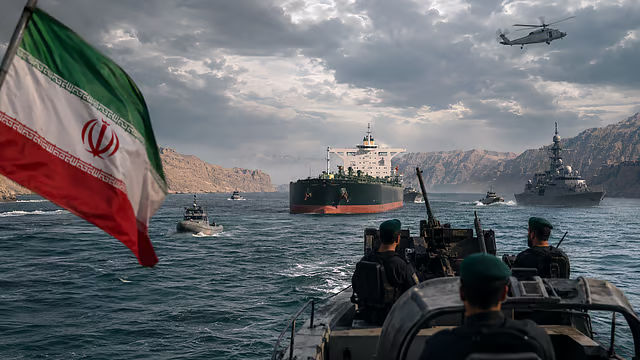
Officials from the United States and Iran say a possible agreement to end the ongoing conflict in the Middle East is moving closer to completion. President Donald Trump said that a deal has been “largely negotiated,” though final details are still being discussed. The announcement comes after weeks of fragile ceasefire conditions and ongoing diplomatic talks.
The statement was shared on the social media platform Truth Social. In it, the Donald Trump said discussions had reached an advanced stage involving multiple countries. He described a recent call with leaders from Qatar, Saudi Arabia, Turkey, Pakistan, Jordan, Egypt, and the United Arab Emirates as “very good.”
According to reports, senior US officials including Vice President JD Vance and special envoy Steve Witkoff also took part in the discussions. Diplomats familiar with the talks said the call showed positive momentum, with progress made toward a broader framework for peace.
Regional leaders have responded cautiously but positively. Pakistan’s Foreign Minister Ishaq Dar praised Trump’s role in encouraging dialogue. Turkish President Recep Tayyip Erdoğan also said his country is ready to support any agreement during its implementation phase.
Trump also confirmed a separate call with Israeli Prime Minister Benjamin Netanyahu, which he said went well. He added that final aspects of the agreement are still being discussed and could be announced soon. One key point reportedly includes reopening the Strait of Hormuz, a critical global shipping route.
US Secretary of State Marco Rubio said there has been “significant progress,” but emphasized that the deal is not yet final. Speaking from India, he said the framework would require full acceptance from Iran and continued negotiations on technical details.
Iranian state media also reported movement toward a possible agreement. Proposals under discussion include lifting oil sanctions and easing restrictions on shipping routes. One plan would allow trade in the Strait of Hormuz to return to pre-war levels within 30 days.
A broader negotiation timeline of about 60 days has been suggested for resolving nuclear-related issues. However, officials on both sides have stressed that major differences still remain, particularly over Iran’s nuclear program and regional influence.
The Iran Foreign Ministry spokesperson Esmaeil Baghaei said the two sides are “very far from and very close to an agreement,” reflecting uncertainty as talks continue. He noted that positions have moved closer but are not yet final.
At the same time, President Trump has maintained a mix of diplomacy and pressure. In comments to Axios, he said there is a “50/50” chance of reaching a deal or escalating military action. This dual approach has raised concerns among analysts about the stability of negotiations.
Some US lawmakers have also expressed concern. Senators Roger Wicker, Ted Cruz, and Lindsey Graham warned that any agreement that allows Iran to maintain its current regime could shift the balance of power in the region. They argued that the terms being discussed may not be strong enough to ensure long-term security.
The conflict began in late February with joint US-Israeli military actions targeting Iran. Since then, tensions have led to rising oil prices and widespread instability across the region. Thousands of people have been killed, including reported losses in Iran and among US forces stationed in the area.
Despite the conflict, diplomatic efforts have continued. Earlier this week, Trump said he paused a planned military strike after allies encouraged further negotiations. This move was seen as a sign that diplomatic channels remain active.
The potential deal is now seen as a critical moment for the region. If finalized, it could ease tensions, reopen trade routes, and reshape relations between the United States and Iran. However, officials on both sides caution that significant gaps still need to be resolved before any final agreement is reached.
