


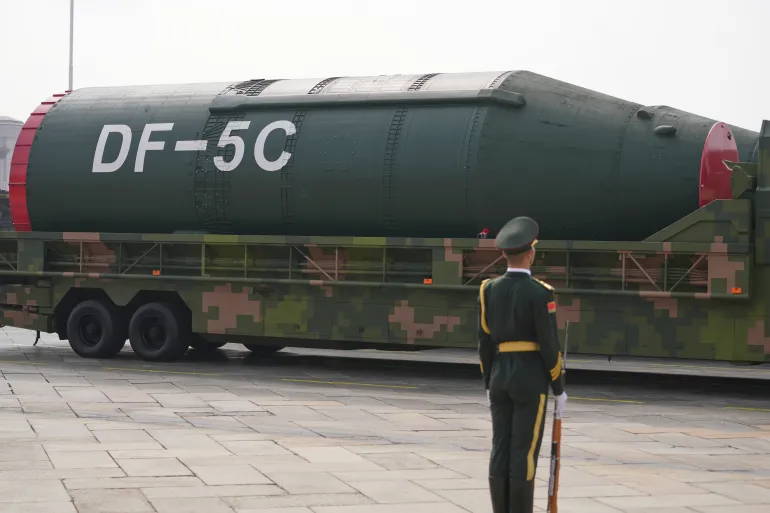
China has carried out a long-range missile test over the Pacific Ocean, raising fresh security concerns among several countries, including the United States, Japan, Australia, and New Zealand. The launch has renewed debate about military transparency and regional stability as tensions remain high in the Indo-Pacific.
According to Chinese state media, the missile was launched on Monday at 12:01 p.m. local time from a nuclear-powered submarine operating in the South Pacific. The ballistic missile landed in what Chinese officials described as “designated waters” in the Pacific Ocean.
China said the launch was part of its annual military training program and described it as a routine exercise. Officials also stated that the test was not aimed at any country or specific target.
Despite those assurances, the missile launch quickly drew concern from several governments. Many officials said the test highlighted the need for greater openness and better communication about military activities in the region.
The United States called on China to improve transparency and increase cooperation on arms control. The U.S. State Department urged Beijing to take part in meaningful discussions on nuclear and missile issues. It also encouraged China to establish a regular notification system for future intercontinental ballistic missile and space launches.
American officials said advance communication between countries can help reduce misunderstandings and lower the risk of military tensions. They stressed that greater transparency is important for maintaining peace and stability across the Indo-Pacific.
Australia also reacted to the launch. Foreign Minister Penny Wong confirmed that China informed the Australian government before the missile test took place. However, she described the action as a destabilizing development for the region.
Wong said Australia remains concerned about China’s rapid military expansion. She added that countries across the Indo-Pacific expect greater transparency and clearer explanations about the purpose of such military activities. Australian officials believe open communication is necessary to maintain trust among regional partners.
Japan expressed similar concerns after receiving advance notice of the launch. Japanese officials said they urged China to reconsider the missile test because of its possible impact on regional security.
The Japanese government also said its coast guard had received information from Chinese authorities about possible falling debris connected to the launch. Some of that debris was expected to fall within Japan’s exclusive economic zone. Officials said they are continuing to monitor the situation closely while maintaining communication with relevant agencies.
New Zealand also voiced concern over the missile launch. Foreign Minister Winston Peters said his government was informed only a few hours before the test took place. While acknowledging the notification, he described the launch as an unwelcome development.
Peters said New Zealand and other Pacific nations do not want the South Pacific to become a testing ground for advanced missile systems. He added that countries in the region value peace and stability and expect military activities to be carried out responsibly.
The missile test comes at a time when security issues in the Indo-Pacific remain a major focus for governments around the world. Several countries have increased defense cooperation in response to rising military activity across the region. The United States, Japan, Australia, and New Zealand continue to support efforts aimed at maintaining a free, open, and stable Indo-Pacific.
Military experts note that submarine-launched ballistic missiles are an important part of modern defense strategies because they provide countries with a mobile and difficult-to-detect launch platform. As a result, tests involving these systems often receive close international attention.
China has repeatedly stated that its military modernization is defensive in nature and intended to protect its national security interests. However, neighboring countries have continued to call for greater openness regarding military planning and weapons development.
The latest missile launch is expected to remain a topic of discussion among regional leaders in the coming weeks. Governments are likely to continue encouraging stronger communication, advance notifications, and diplomatic dialogue to reduce the risk of misunderstandings and maintain stability throughout the Pacific region.
