


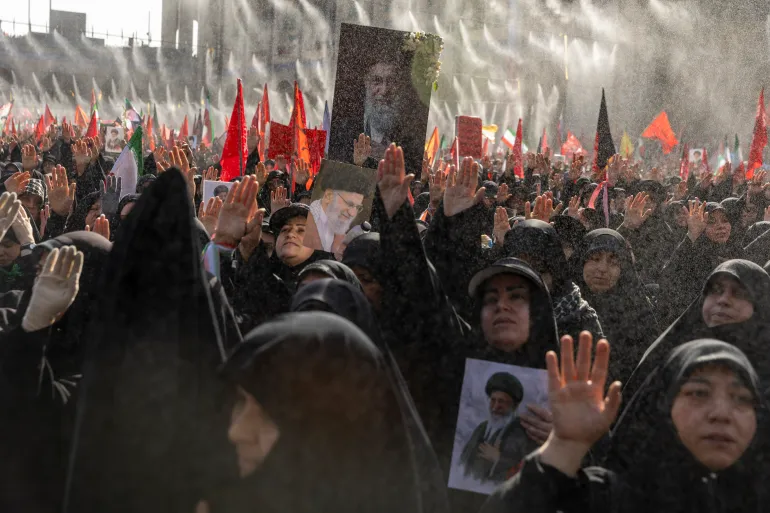
Thousands of people gathered in Tehran as the Ali Khamenei funeral ceremony entered its second day, with family members, senior government officials, and mourners attending public events held in honor of Iran’s late supreme leader.
State television showed three of Khamenei’s sons, Mostafa, Meysam, and Masoud Khamenei, taking part in prayers during the ceremony. They stood behind several coffins placed inside the large courtyard of the Imam Khomeini Grand Mosalla, one of Tehran’s biggest religious complexes.
However, Mojtaba Khamenei, who succeeded his father as Iran’s supreme leader, did not appear at the public ceremony. His absence drew attention because he has not been seen publicly since assuming the country’s highest leadership position earlier this year.
According to reports, security concerns are believed to be the main reason for Mojtaba Khamenei’s absence. Analysts have suggested that potential threats against his life have limited his public appearances following the recent conflict involving Iran, the United States, and Israel.
The funeral follows the death of Ali Khamenei and several members of his family during an airstrike on February 28. Iranian officials said those killed included his daughter, son-in-law, daughter-in-law, and his 14-month-old granddaughter.
Large crowds continued to arrive throughout the day to pay their respects. Many mourners carried Iranian national flags along with red flags, which are widely recognized in Iran as symbols of sacrifice and calls for justice after the loss of prominent figures.
State media showed long lines of people moving through the funeral area as prayers and religious ceremonies continued. Many participants gathered to honor Khamenei’s decades of leadership and express support for the country’s political system.
Some mourners also chanted political slogans during the ceremony. Demonstrators voiced strong criticism of the United States and Israel while expressing support for Iran’s leadership following the recent conflict.
The Iranian government has organized a week-long series of funeral events to honor the late leader. The official program includes ceremonies in several major cities before Khamenei is laid to rest.
According to government plans, the funeral procession will also travel through important Shia religious sites. These include the holy cities of Karbala and Najaf in Iraq, as well as Qom and Mashhad in Iran. Khamenei is expected to be buried in Mashhad, his hometown, after the public ceremonies conclude.
Senior Iranian leaders attended the funeral alongside members of Khamenei’s family. Among those present were President Masoud Pezeshkian, Parliament Speaker Mohammad Bagher Ghalibaf, and Quds Force commander Esmail Qaani.
Foreign representatives and dignitaries also attended earlier private memorial events before the public ceremonies began. The funeral has become one of the largest public gatherings in Iran this year.
Ali Khamenei served as Iran’s supreme leader for 36 years, making him one of the country’s longest-serving political figures. During his leadership, he played a central role in shaping Iran’s domestic policies, foreign relations, and security strategy.
The office of supreme leader is the highest authority in Iran’s political system. The position holds significant influence over national policy, the armed forces, and major state institutions.
The recent conflict that led to Khamenei’s death has further increased tensions across the region. International observers continue to monitor developments closely as Iran begins a new chapter under Mojtaba Khamenei’s leadership.
Security remains high throughout Tehran as funeral events continue. Authorities have increased protection around key government buildings, religious sites, and public gathering areas while large crowds continue to attend memorial services.
The Ali Khamenei funeral ceremony is expected to continue over the coming days before the late leader is buried in Mashhad. Officials expect thousands more people to participate in the remaining events as Iran completes one of the most significant state funerals in its recent history.
