


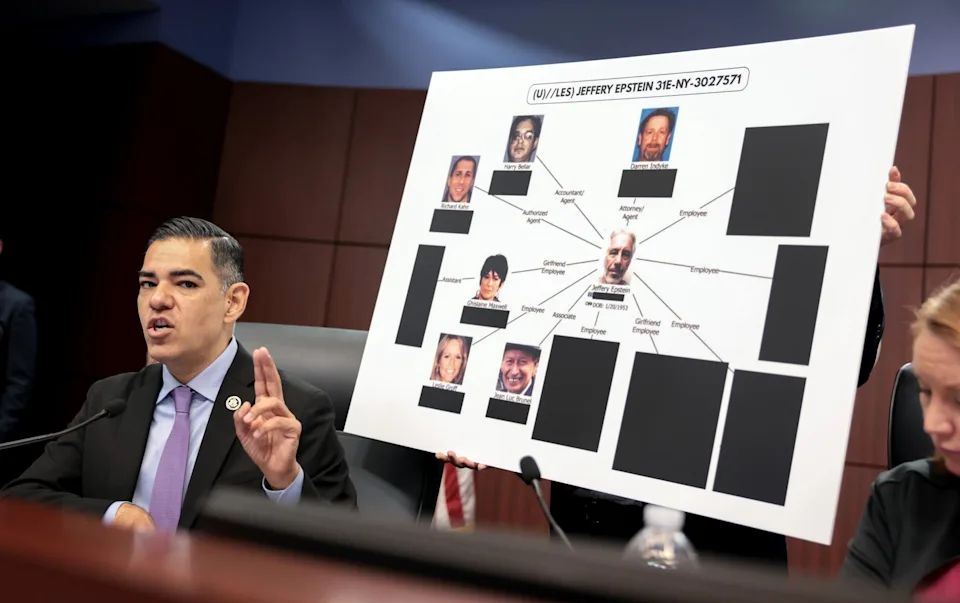
Epstein assistant Groff has come under renewed scrutiny as US lawmakers investigate the extent of knowledge held by Jeffrey Epstein’s long-time executive assistant, Lesley Groff, and her role in managing his daily life for nearly two decades.
Apart from Epstein himself, Groff’s name appears more frequently than almost anyone else in the newly released Department of Justice documents linked to the late financier’s network. According to the files, her name appears more than 160,000 times, placing her at the center of Epstein’s professional and social operations.
The investigation is now expected to intensify as Groff prepares to testify before the US House of Representatives Oversight Committee in Washington, where lawmakers aim to better understand the inner workings of Epstein’s circle and how his operations functioned for years without full public exposure.
Lesley Groff worked for Epstein from 2001 until his death in 2019. During that time, she managed his diary, coordinated travel, scheduled meetings, and handled communications with some of the world’s most powerful figures who interacted with him.
Her role placed her at the center of Epstein’s daily operations, including organizing meetings, flights, and personal arrangements involving guests, staff, and associates. Former colleagues and investigators have described her as a key logistical figure in Epstein’s tightly controlled environment.
Supporters of Groff argue she was a highly efficient assistant operating under strict instructions and limited visibility into Epstein’s private actions. Her legal representatives maintain that she was deliberately kept away from any criminal activity and misled about the nature of his conduct.
However, critics and survivors have raised questions about how someone in such a central position could have remained unaware of Epstein’s abuse, especially given her involvement in scheduling massages and coordinating visits to his properties.
Epstein himself once described his assistants as an “extension of his brain,” emphasizing their role in managing his complex schedule and extensive network of contacts, including influential figures in politics, business, and entertainment.
Lawmakers and investigators are particularly focused on Epstein’s so-called “massage appointments,” which were regularly scheduled by Groff as part of her administrative duties. These appointments have long been associated with allegations of abuse by Epstein’s victims.
Some survivors have suggested that individuals within Epstein’s inner circle may have been aware of suspicious activity. However, Groff has consistently denied any knowledge of illegal conduct.
After Epstein’s 2008 conviction in Florida on charges including procuring a minor for prostitution, he served 18 months in prison under a controversial plea agreement that granted him significant legal protections. Groff continued working for him after his release.
Her continued employment during that period has become a focal point in the current investigation, as lawmakers question whether key staff members recognized warning signs or were shielded from them.
Documents reviewed by investigators show Groff also handled financial transactions, travel arrangements, and logistical support for women and guests visiting Epstein’s properties. She was also involved in arranging visas, accommodation, and scheduling international travel.
Legal experts note that while assistants often manage sensitive schedules, Groff’s proximity to Epstein’s daily operations makes her testimony potentially significant for understanding how his network functioned.
Despite years of public scrutiny surrounding Epstein’s case, Groff herself has never been charged with any criminal offense. Previous investigations were dropped, and civil cases involving her were either withdrawn or dismissed.
Her lawyer has argued that Epstein deliberately isolated staff from his illegal activities and created a divided environment in which his legitimate and illegal operations were kept separate.
The upcoming congressional hearing is expected to examine not only Groff’s actions but also broader questions about how Epstein maintained access to powerful individuals while operating a concealed criminal network.
Lawmakers hope her testimony may provide clarity on how Epstein coordinated his activities and whether others in his inner circle had any awareness of wrongdoing.
However, uncertainty remains over how much insight she can provide. While she was deeply embedded in Epstein’s daily operations, there is still no publicly confirmed evidence proving she had direct knowledge of his crimes.
As the investigation continues, the case highlights the challenges of determining responsibility within complex networks where administrative staff operate close to high-profile figures but may not be privy to all aspects of their conduct.
The testimony of Epstein assistant Groff is now expected to be one of the most closely watched moments in the ongoing effort to fully map the scope of Epstein’s network and the roles played by those around him.
