


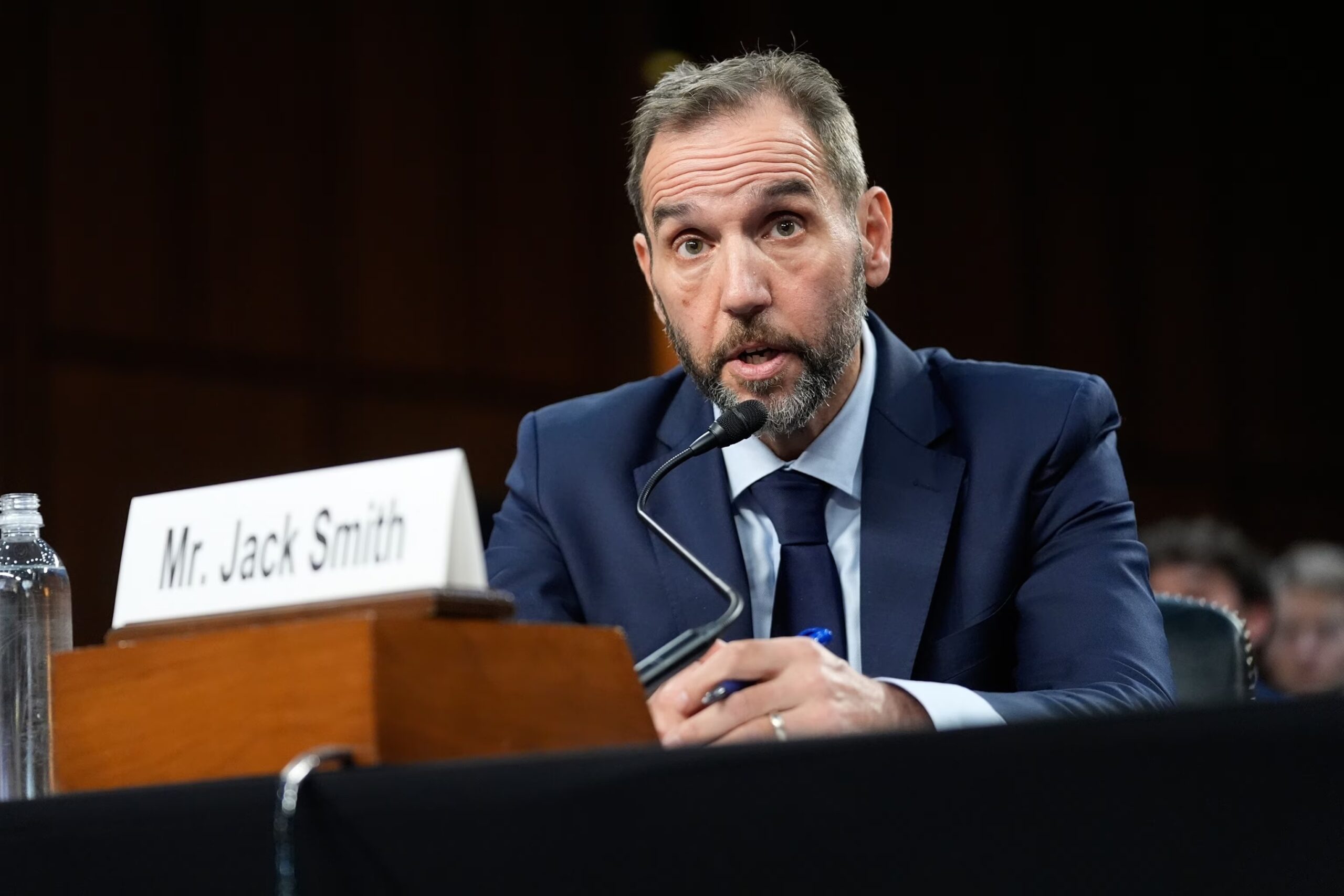
Former special counsel Jack Smith faced intense questioning before the Senate Judiciary Committee as Republican lawmakers continued a long-running effort to examine his investigation into President Donald Trump. What was expected to be a major hearing instead became a tense political battle marked by sharp criticism, procedural disputes, and a mistaken claim involving a basketball game.
Republican senators entered the hearing hoping to uncover evidence supporting their argument that Smith’s investigation was politically motivated. The hearing marked Smith’s third sworn appearance before Congress and his second public testimony. Many lawmakers viewed it as a key moment ahead of the upcoming midterm elections.
The session quickly turned confrontational. Several Republican senators launched personal attacks while questioning Smith about his handling of the federal investigation into Trump’s efforts to challenge the 2020 election result.
Missouri Senator Eric Schmitt accused Smith of participating in a hidden effort connected to election investigations. Louisiana Senator John Kennedy delivered strong criticism of the former prosecutor. Texas Senator Ted Cruz argued that Smith’s actions represented a major misuse of authority within the Justice Department.
Despite the heated exchanges, little new information emerged during the four-hour hearing. Senate Judiciary Committee Chairman Chuck Grassley said the committee’s work would continue. However, the hearing also suggested that the Republican-led congressional investigation may be nearing its final stage after two years of inquiries.
Some Republicans appeared ready to move on. Missouri Senator Josh Hawley said lawmakers largely understood the facts already gathered. He argued that any future action should come from the Justice Department or legal disciplinary bodies rather than Congress.
Democrats used the hearing to defend the investigation and challenge claims that it was driven by politics. Smith also pushed back against accusations from Republican lawmakers. He said investigators followed established rules and respected legal limits throughout the process.
According to Smith, the investigation relied heavily on testimony from Republicans who served in government during and after the 2020 election. He argued that those witnesses played a key role in helping investigators understand events surrounding efforts to overturn the election outcome.
Smith said it was difficult to label the investigation as partisan because many of the most important witnesses were Republicans. He pointed to individuals who publicly rejected claims of widespread election fraud and later cooperated with investigators.
The former special counsel also defended members of his investigative team. He criticized the decision by the current Justice Department to dismiss some staff members and said he believed those actions were improper. Smith praised his team’s work and said investigators acted within the law.
A major focus of the hearing involved the use of subpoenas during the investigation. Republican lawmakers questioned Smith about obtaining phone records connected to members of Congress who had communicated with Trump after the 2020 election.
Lawmakers also raised concerns about secrecy orders that prevented telecommunications companies from informing those lawmakers about the subpoenas. Critics argued that such actions raised constitutional concerns and could affect the balance between branches of government.
The issue produced one of the hearing’s rare bipartisan moments. Democratic Senator Chris Coons and Republican Senator Mike Lee discussed potential legislation that could limit secrecy orders in sensitive investigations. Both lawmakers suggested the topic deserved further review.
Smith defended those investigative steps. He said prosecutors sought evidence directly related to the case and followed legal procedures approved by courts. He maintained that investigators never targeted lawmakers because of their political positions.
One of the hearing’s most memorable moments came during an exchange between Schmitt and Smith. Schmitt presented text messages that he claimed showed Smith traveling to Atlanta during a key period in another election-related case. The senator suggested the trip might have been linked to investigative activity.
Smith appeared confused by the accusation before eventually recalling the event in question. He explained that the messages referred to a college basketball game in Maryland featuring Iowa star Caitlin Clark, not a professional game in Atlanta.
The clarification quickly drew attention. Democratic Senator Amy Klobuchar challenged Schmitt’s claim and noted that public records confirmed the Maryland game took place on the date mentioned in the text messages. She argued that the accusation was based on incorrect assumptions.
By the end of the hearing, the focus had shifted away from claims of a major breakthrough. Instead, the session highlighted ongoing disagreements over Smith’s investigation, congressional oversight, and the legal battles that continue to shape the political landscape.
