


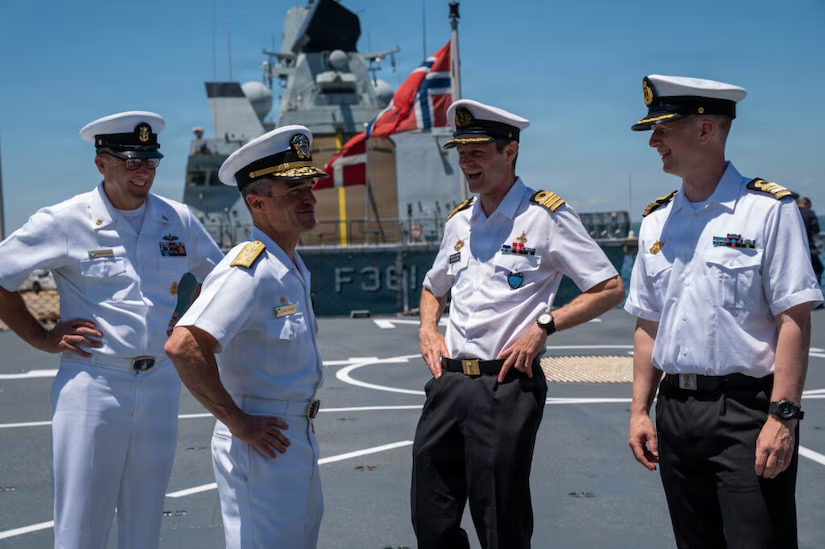
Fleet Exercise 250 has officially begun as the United States Navy’s Second Fleet and international partners launched a large multinational maritime drill in the Atlantic Ocean near Norfolk, Virginia. The operation marks one of the most significant joint naval training events in the region this year, bringing together warships, aircraft, and crews from multiple countries to improve coordination and readiness at sea.
The Fleet Exercise 250 involves 31 warships along with multinational aircraft and personnel from across allied nations. The training is designed to strengthen interoperability between partner navies and test their ability to operate together in a complex, multidomain environment. Officials say the exercise focuses on building coordinated responses across air, surface, and underwater operations in conditions designed to simulate real combat scenarios.
The exercise includes a wide range of naval warfare training, such as anti-air, anti-submarine, and amphibious operations. It will conclude with a scenario-based “battle problem” that challenges participating forces to respond to a dynamic adversary. Military planners say the goal is to improve tactical readiness and ensure that allied forces can act as a unified fleet during potential future operations.
Fleet Exercise 250 is structured in two main phases. The first phase, known as the harbor phase, runs from today until June 21 and is taking place at Naval Station Norfolk. During this stage, participating nations will conduct final planning sessions, briefings, and coordination activities before heading to sea. The second phase begins on June 22 and continues through June 29, during which ships will deploy into the Atlantic to carry out live training exercises and fleet formations.
The exercise officially opened with a reception aboard the amphibious assault ship USS Iwo Jima, marking the start of a week of coordination and integration activities. Navy Vice Admiral Doug Perry, commander of the US Second Fleet, said the exercise provides a valuable opportunity for allied forces to operate as a unified team. He said joint training helps sharpen operational readiness and reinforces shared commitments to maritime security and stability in the Atlantic region.
Participating countries in Fleet Exercise 250 include Belgium, Brazil, Canada, Cameroon, Côte d’Ivoire, Cyprus, Denmark, France, Germany, Mexico, Morocco, the Netherlands, Norway, Peru, Senegal, Spain, Turkey, the United Kingdom, and the United States. The broad participation highlights the international scope of the operation and the shared focus on maritime cooperation among allied navies.
In addition to military training, the exercise is also linked with public events in Norfolk, including the Norfolk Harbor Fest, Virginia SAIL 250, and Norfolk Fleet Week. These events will allow members of the public to tour visiting warships and tall ships and take part in celebrations such as a Parade of Sail. Organizers say this provides a rare opportunity for civilians to engage directly with international naval personnel and experience maritime traditions up close.
Following the completion of Fleet Exercise 250, many of the participating ships, along with historic tall ships, will continue to New York City. There, they will take part in the International Naval Review 250 scheduled for July 3 to July 8. The event will be part of broader commemorations marking the United States’ 250th anniversary.
Officials say Fleet Exercise 250 not only strengthens operational capabilities but also reinforces long-standing partnerships among allied nations. The exercise is intended to ensure that multinational naval forces can operate effectively together in future missions, while also showcasing unity and cooperation on the global stage.
