


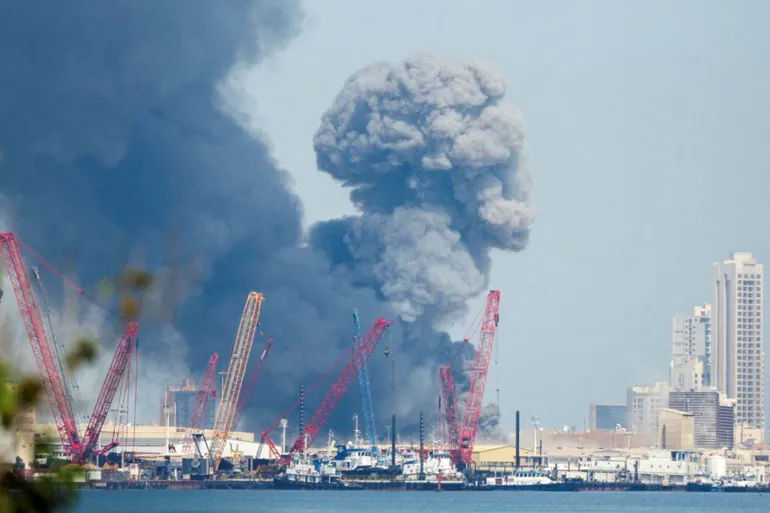
The United States military said it carried out a new round of airstrikes against targets in Iran on Wednesday, describing the operation as part of ongoing military action ordered by President Donald Trump. According to the U.S. military, the strikes focused on military facilities and command infrastructure at several locations, including Bandar Abbas, one of Iran’s most important port cities.
The operation marks another development in the continuing conflict that has increased tensions across the Middle East. Military officials said the strikes were aimed at reducing Iran’s military capabilities while protecting U.S. interests in the region.
According to the U.S. Central Command, American forces targeted command centers, air defense systems, missile sites, drone capabilities, and coastal surveillance facilities. Officials said the strikes were carried out at multiple locations across Iran.
One of the main locations identified was Bandar Abbas. The city sits along the Strait of Hormuz, one of the world’s busiest shipping routes for oil and natural gas. Bandar Abbas is also home to Iran’s largest commercial port and major naval facilities used by both the Iranian Navy and the Islamic Revolutionary Guard Corps.
Military officials stated that the operation included strikes against facilities believed to support military activities in the area. They said the objective was to weaken operational capabilities linked to missile systems, coastal defenses, and military command structures.
The U.S. military also reported that American forces carried out a separate wave of strikes on Greater Tunb Island. According to the official statement, the operation lasted about 90 minutes and focused on coastal defense positions and cruise missile sites.
Greater Tunb Island is located near the entrance to the Strait of Hormuz, making it strategically important because of its position along a major international shipping lane.
The latest military action follows recent statements from President Trump about possible additional measures against Iran. During recent public remarks, the president repeated warnings that the United States could target Iranian energy facilities if tensions continue to increase.
The comments have drawn international attention because energy infrastructure plays an important role in both the global economy and civilian life. Any military action involving critical infrastructure could have broader economic effects beyond the region.
International humanitarian law also remains part of the discussion surrounding the conflict. The Geneva Conventions establish rules intended to protect civilians during armed conflict. These agreements prohibit attacks on certain civilian facilities and infrastructure considered essential for civilian survival.
Some legal experts have previously argued that attacks on protected civilian infrastructure could raise questions under international law. Others note that the legal assessment of any military action depends on the specific target, its military use, and the circumstances surrounding the operation.
The latest strikes come during a period of continued military confrontation involving the United States, Israel, and Iran. The conflict has expanded over recent months, affecting several countries across the region and increasing concerns about regional stability.
Military operations have also affected commercial activity. The Strait of Hormuz remains one of the world’s most important maritime routes for energy exports. Any disruption in the area can influence global oil supplies and international shipping.
Financial markets have closely followed developments in the region. Rising geopolitical tensions have contributed to higher oil prices and increased uncertainty for investors. Energy markets continue to react to reports of military activity near major shipping routes.
Governments and international organizations are also monitoring the situation because of its humanitarian impact. Ongoing military operations have displaced large numbers of people and caused significant damage in affected areas. Aid organizations continue to express concern about civilian safety as the conflict continues.
The United States has not announced whether additional military operations are planned. Officials have said they will continue monitoring security conditions and responding to threats as necessary.
The latest announcement highlights the continuing volatility in the Middle East. As diplomatic efforts remain uncertain, military developments are likely to remain a major focus for governments, businesses, and global markets in the weeks ahead.
