


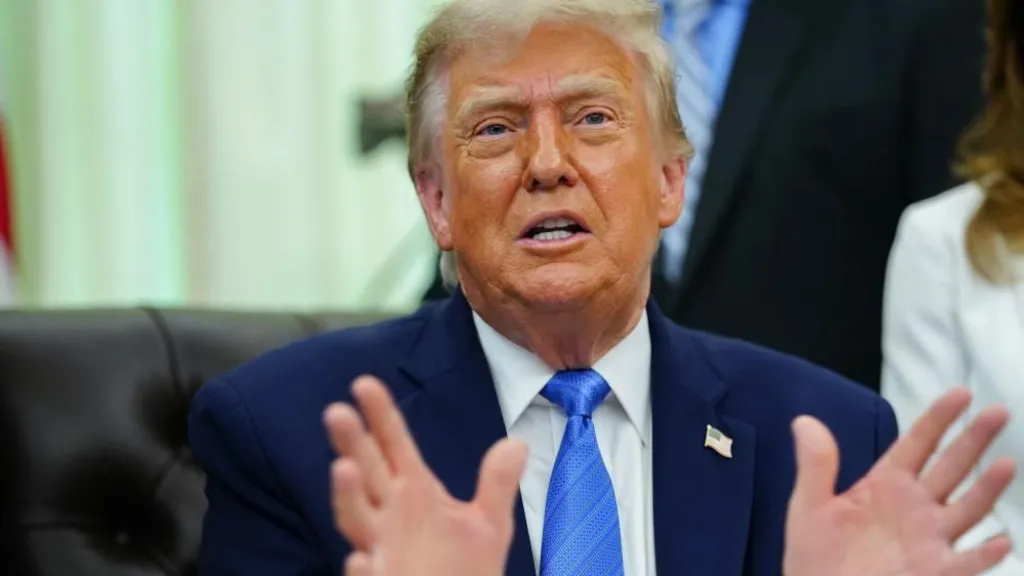
President Donald Trump said the United States will carry out another round of military strikes against Iran after both countries exchanged attacks for a second straight day. His comments came during a briefing at the White House, where he warned that Washington would continue its military response unless a broader agreement is reached.
Speaking to reporters, Trump said the United States had already struck Iranian targets and would “hit them hard again today.” The statement followed overnight military operations that increased fears of a wider conflict across the Middle East.
US Central Command later confirmed that American forces began launching attacks against multiple targets inside Iran during the evening. Military officials described the operation as a response to what they called Iran’s continued aggression and said the strikes focused on selected military facilities.
Iranian President Masoud Pezeshkian responded by saying the country would remain firm against pressure and threats. Iranian officials also criticized Washington, arguing that repeated military action and changing positions have damaged diplomatic efforts aimed at reducing tensions.
The latest exchange follows US strikes carried out a day earlier after President Trump said an American Army helicopter had been brought down. Iran’s Islamic Revolutionary Guard Corps answered by launching attacks on US military bases across the region.
US Defense Secretary Pete Hegseth supported the president’s position, saying Iran had been given opportunities to reach an agreement but had failed to do so. He added that bombs would continue to target key facilities if necessary.
Trump also repeated his demand for Iran to accept a new agreement, saying negotiations had taken too long. In a social media post, he claimed Iran had been completely defeated militarily and warned that continued delays would bring further consequences.
The conflict also affected maritime security in the Gulf region. The US military announced that it had struck an oil tanker in the Gulf of Oman, claiming the vessel violated an ongoing blockade by attempting to transport Iranian oil.
Indian authorities said three Indian sailors were reported missing after an attack on the ship Settebello near the coast of Oman. Officials also confirmed that 21 crew members had been rescued.
The United States has maintained a blockade on Iranian ports after the Strait of Hormuz became heavily restricted following earlier military clashes. The narrow waterway is one of the world’s most important energy shipping routes, making any disruption a major concern for global markets.
According to US military officials, Tuesday’s strikes targeted Iranian defense systems, radar sites, and ground control stations located near the Strait of Hormuz. Iranian media reported that two water reservoirs were also damaged, leaving thousands of residents in the southern port town of Sirik without drinking water for several hours.
Iran’s Revolutionary Guard said it launched attacks on 21 American targets across the Middle East, including military installations in Bahrain and Jordan. Kuwait also reported that its air defense systems intercepted incoming aerial threats.
US officials said nearly all Iranian missiles and drones fired at American bases were intercepted successfully, with no casualties reported.
The current conflict began on February 28 after US and Israeli military operations inside Iran triggered a broader regional crisis. Iran responded with attacks on Israel and allied countries in the Gulf, while fighting later expanded into neighboring Lebanon.
Although both sides agreed to a temporary ceasefire in April, intermittent exchanges of fire have continued and diplomatic talks have struggled to produce a lasting solution.
Nuclear issues remain at the center of negotiations. Trump said the proposed agreement would completely prevent Iran from ever obtaining a nuclear weapon. At the same time, the International Atomic Energy Agency approved a resolution calling on Iran to provide additional information about its uranium stockpile and production facilities.
Iran has criticized the resolution and continues to insist that its nuclear program is intended only for peaceful purposes. As military operations continue and diplomatic efforts face new challenges, international leaders are closely watching developments that could shape security across the Middle East and beyond.
