


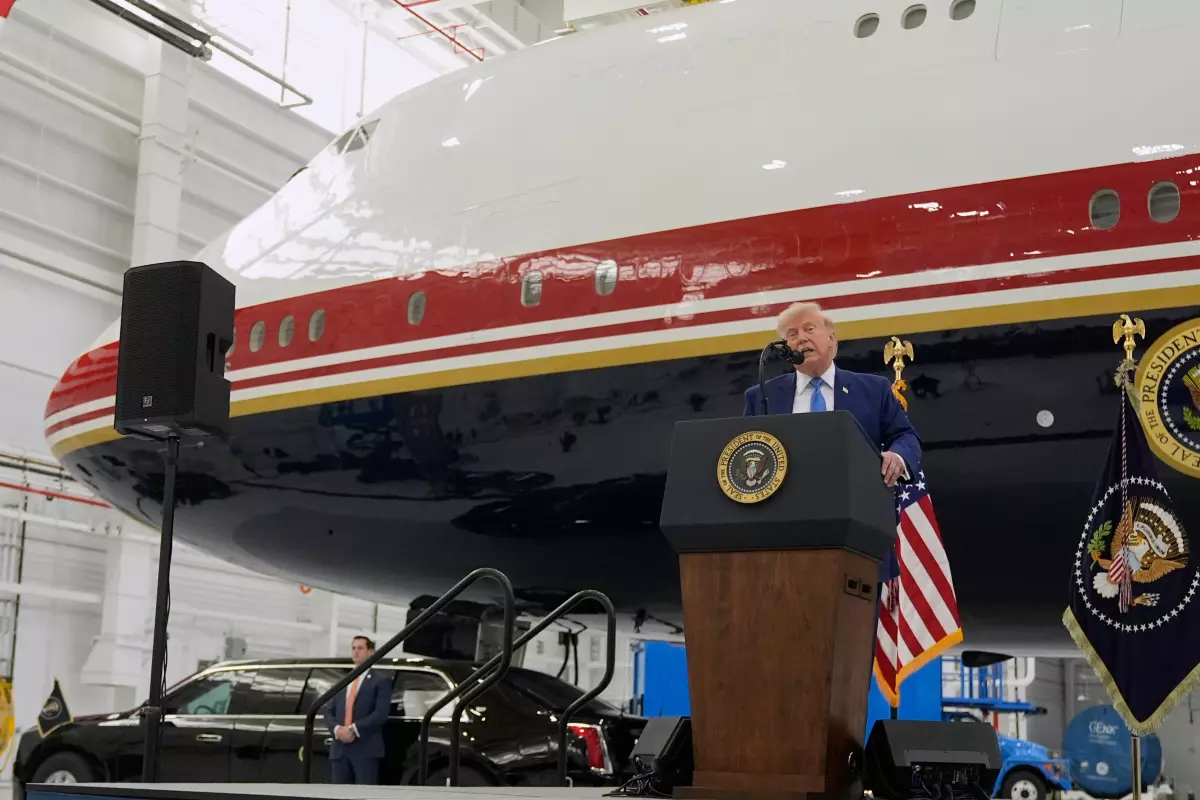
Donald Trump has introduced a new temporary presidential aircraft during a public event at Joint Base Andrews in Maryland. The jet will serve as a short term version of Air Force One until new long term aircraft are delivered in the coming years.
The aircraft is a modified Boeing 747 that has been redesigned for presidential use. It carries a VC-25B designation and features a red, white, dark blue, and gold color scheme. The design is similar to Trump’s personal aircraft style and marks a visible shift in the presidential fleet appearance.
The jet was gifted by the state of Qatar and has triggered political debate in Washington. Critics argue that the value of the aircraft, estimated at around 400 million dollars, exceeds federal limits on gifts to government officials. The legal threshold for unsolicited gifts is far lower, raising questions about compliance and ethics.
Trump rejected criticism during the event. He said it would be “stupid” to refuse the aircraft when offered. Officials from the defense sector also defended the decision. Pentagon spokesperson Sean Parnell said the acceptance followed federal rules and proper procedures.
The conversion of the aircraft is expected to cost about 1 billion dollars. The jet will act as a bridge solution while the United States waits for two new presidential aircraft. Those planes are currently scheduled for delivery in 2027 and 2028. However, the overall program cost has increased significantly over time and now stands at around 5 billion dollars.
The current presidential fleet includes two aging Boeing 747 aircraft that entered service in 1990. These planes have been in use since the presidency of George H. W. Bush. Over time, maintenance costs and technical issues have increased, leading officials to look for replacement options.
Earlier this year, one of the presidential jets had to return to Washington during a trip to Europe due to a minor electrical issue. Officials said the crew acted quickly and safely brought the aircraft back to base. While no major damage occurred, the incident highlighted the challenges of operating older aircraft.
Air Force officials said the new jet was fast tracked to meet operational needs. Some planned upgrades for the next generation aircraft were delayed in order to deliver this temporary solution sooner. Despite this, officials said the aircraft meets required safety and security standards for presidential travel.
Troy Meink, the secretary of the air force, said safety remains the top priority. He added that every requirement was carefully reviewed while speeding up delivery. Officials stressed that the aircraft still meets strict standards required for transporting the president.
The new jet was presented at Joint Base Andrews, a key military airport used for presidential travel and international flights. The aircraft will support official missions until the next generation fleet is ready.
The interior of the jet includes luxury features and decorative elements. Reporters who toured the aircraft noted high end design choices and customized details. One unusual feature includes a framed artwork showing a duck near the Lincoln Memorial reflecting pool.
The arrival of the aircraft also coincides with the retirement of one of the older presidential planes, which is expected to be preserved in a museum. The second aircraft in the current fleet will continue flying alongside the new temporary jet.
The timing of the rollout is also linked to upcoming national celebrations. A major formation flight over Washington DC is planned for July 4 to mark the 250th anniversary of the United States. Trump said the new aircraft will lead what he described as a historic flyover event.
Officials say concerns that the aircraft could be used for personal travel after Trump leaves office are unlikely due to extremely high operating costs. A single flight hour for a Boeing 747 can cost between 180,000 and 200,000 dollars, making private use highly impractical.
Supporters argue that the aircraft provides a necessary upgrade during delays in the official fleet program. Critics continue to question the cost, ethics, and long term planning of the decision. The debate highlights wider concerns about defense spending, procurement delays, and government transparency.
As the temporary aircraft enters service, it becomes part of a broader discussion about how the United States maintains its presidential transport system in an era of rising costs and aging infrastructure. The coming years will determine whether the bridge solution successfully meets operational needs until the new fleet is delivered.
