


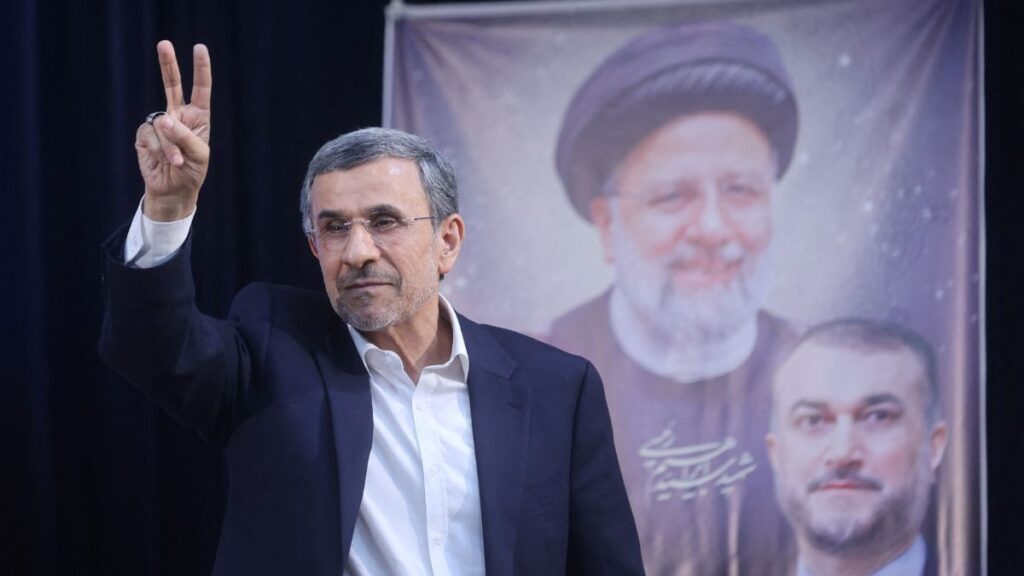
The question of Ahmadinejad Iran leadership has emerged amid reports that US and Israeli planners considered former Iranian president Mahmoud Ahmadinejad as a possible figure to lead Iran in a post-conflict scenario. The claim has added a new layer of complexity to already heightened tensions in the Middle East, following strikes and ongoing political instability tied to Iran’s government.
The idea surfaced in the context of broader discussions around “regime change” strategies reportedly supported at the outset of recent US and Israeli military actions. According to the reports, some planners believed Ahmadinejad could play a role in a transitional leadership arrangement. However, the proposal appears highly controversial given his long history of confrontation with the West and his deeply polarizing political record.
Ahmadinejad served as president of Iran from 2005 to 2013 and remains one of the country’s most internationally recognized political figures. Born in 1956 in Aradan, near Tehran, he rose from a modest background. His early life included engineering studies, later earning a doctorate in traffic and transport from Iran’s University of Science and Technology in Tehran. Before entering national politics, he was active in student organizations and held administrative roles in local government.
During and after the 1979 Islamic Revolution, Ahmadinejad’s role has been widely debated. Some accounts describe him as involved in revolutionary student activity, while he has denied allegations linked to the US embassy hostage crisis. He later served in several provincial administrative positions, including governorships in northwest Iran, building his political base over time.
His national prominence increased when he became mayor of Tehran in 2003. Though relatively unknown at the time, he gained attention for combining conservative social policies with efforts to improve urban services. In 2005, he shocked many observers by winning Iran’s presidential election against former president Akbar Hashemi Rafsanjani. His victory was seen as a major shift toward hardline politics within Iran’s system.
As president, Ahmadinejad became a central figure in Iran’s confrontation with Western powers. He strongly defended Iran’s nuclear program and frequently criticized the United States and Israel. His rhetoric, including claims widely condemned internationally, made him a highly controversial figure. His presidency also included disputed elections, most notably in 2009, when his re-election triggered mass protests and a harsh government crackdown.
Tensions between Ahmadinejad and Iran’s Supreme Leader Ayatollah Ali Khamenei grew after 2011. Disagreements over ministerial appointments and political authority weakened his position. After leaving office in 2013, he was gradually sidelined from mainstream Iranian politics. Despite several attempts to run again for president, he was repeatedly disqualified by Iran’s electoral oversight bodies.
In recent years, Ahmadinejad has remained a politically sensitive figure inside Iran. Reports suggest he has been under close state monitoring and limited political influence. His continued relevance in Iranian politics, however, has kept him in public discussion, especially during periods of crisis or instability.
The latest claims about his potential role in leadership plans stem from reports suggesting that US and Israeli strategy included “regime change” thinking. According to these accounts, some analysts believed Ahmadinejad’s knowledge of Iran’s political system could make him useful in a transitional phase. However, other officials reportedly rejected the idea due to his past hostility toward Israel and the West.
The reported plan is said to have involved removing key elements of Iran’s current leadership structure in the event of escalation. It also allegedly considered alternative political figures who could stabilize the country afterward. Ahmadinejad’s name reportedly appeared in internal discussions, although there is no confirmed indication of formal policy adoption.
At the same time, skepticism remains high. Analysts note that Ahmadinejad’s political identity is closely tied to hardline nationalism and anti-Western rhetoric. His past statements on Israel and the Holocaust have made him deeply controversial internationally. This raises questions about whether he could realistically serve as a consensus figure in any transitional arrangement.
Iranian officials have not directly commented on the specific claims regarding Ahmadinejad’s role in foreign planning discussions. The Iranian government has instead focused on rejecting broader allegations of external interference in its political system. Meanwhile, US officials have emphasized that their military and diplomatic objectives are focused on regional security and nuclear non-proliferation.
The debate over Ahmadinejad Iran leadership highlights the uncertainty surrounding future political scenarios in the region. With ongoing tensions between Iran, the United States, and Israel, discussions about leadership succession and regime stability continue to draw international attention. However, no evidence suggests that any leadership transition involving Ahmadinejad is currently underway or formally supported.
