


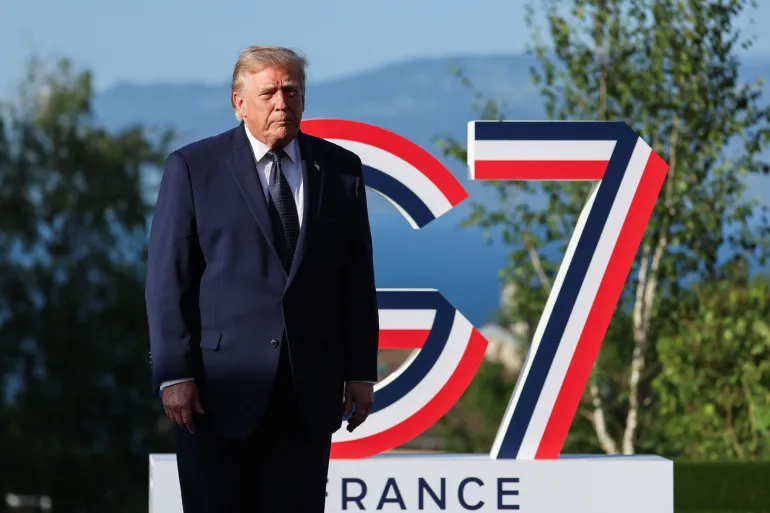
US President Donald Trump arrived at the G7 summit in France with strong claims about a new preliminary Iran deal and renewed ambitions to end major global conflicts, including the war in Ukraine and ongoing tensions in Lebanon. His arrival in Evian-les-Bains on Monday set the stage for high-level talks with world leaders, as allies expressed both cautious optimism and concern over his approach to foreign policy.
Trump promoted the US Iran deal as a major diplomatic success, saying it marks a turning point in relations with Tehran. He said the agreement could help reduce tensions in the Middle East and bring wider economic benefits, including lower oil prices and improved global market stability. According to Trump, financial markets have already reacted positively, with falling oil prices and rising stock activity.
During a meeting with French President Emmanuel Macron, Trump described the deal as a breakthrough that could reshape regional politics. He said the United States was moving toward a more stable phase in its relationship with Iran after years of conflict and confrontation. He added that the agreement would support broader peace efforts in the region.
However, despite the optimistic tone from Trump, many G7 partners remain cautious. Several leaders are concerned about the lack of prior consultation before major decisions were made regarding military actions and diplomatic negotiations. Some European officials have also raised concerns about recent US tariff threats and Washington’s broader foreign policy direction.
The US Iran deal remains a preliminary framework, but Trump insisted that some progress is already visible. He said maritime traffic through key routes, including the Strait of Hormuz, is expected to resume without disruption. France, Britain, and Germany have reportedly offered support to help secure the waterway, although Trump suggested that international assistance may not be necessary.
He told Macron that commercial shipping was already beginning to move more freely and that the situation was stabilizing faster than expected. Still, he acknowledged that having allied naval support in the region would not be a negative step.
Beyond the Middle East, Trump said his administration is now focusing on ending the war between Ukraine and Russia. He claimed to have held recent discussions with Ukrainian President Volodymyr Zelenskyy and Russian President Vladimir Putin, saying both sides may be open to negotiations. According to Trump, there is a possibility of further diplomatic progress if talks continue.
A Ukrainian official said Zelenskyy had expressed willingness to meet both Putin and Trump during the G7 summit, along with European leaders. However, the Kremlin did not respond to the proposal. Russia’s position remains complicated by international legal issues, including an International Criminal Court warrant for Putin on war crimes charges.
The G7 summit itself is expected to address a wide range of global issues beyond conflict zones. Leaders are set to discuss economic stability, trade imbalances, artificial intelligence regulation, and the growing global influence of China, particularly in the rare earth minerals sector, which is essential for modern electronics and technology.
Tensions between the United States and its allies have also been a key theme at the summit. Some leaders have criticized Washington’s approach to military coordination and its use of tariffs. Others are concerned about the impact of political rhetoric on NATO unity and global cooperation.
Despite these concerns, Trump presented his diplomatic efforts as successful and forward-moving. He emphasized that his administration is actively working on multiple peace initiatives at once, including Iran, Ukraine, and Lebanon. He argued that these efforts could reshape global stability if agreements continue to progress.
As discussions continue in France, the G7 summit is shaping up to be a test of international cooperation amid shifting geopolitical priorities. While Trump highlights diplomatic breakthroughs and potential peace deals, other world leaders remain focused on ensuring that agreements are stable, coordinated, and supported by all major partners.
