


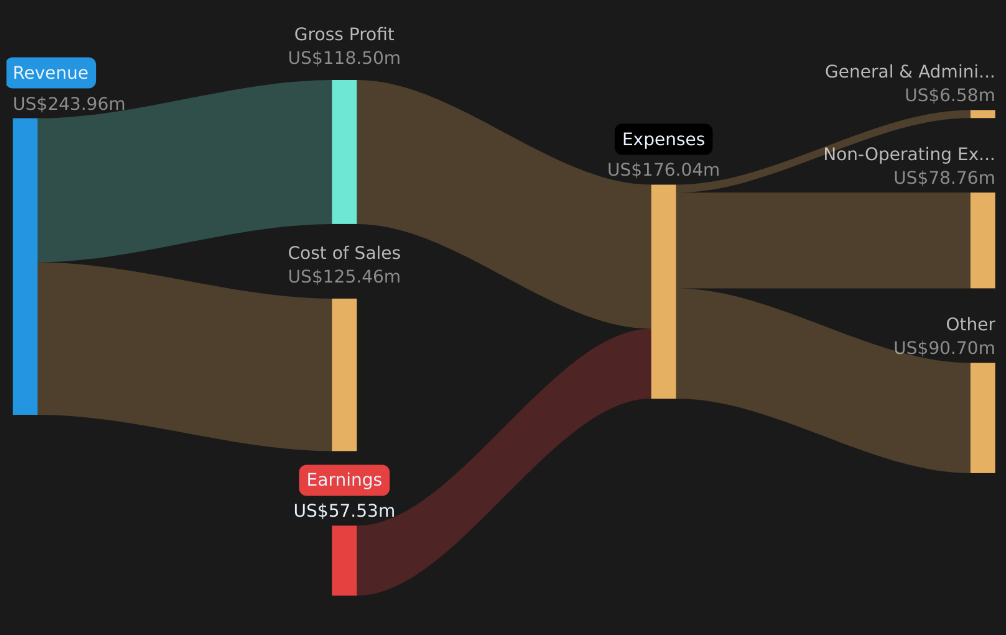
KBS Real Estate Investment Trust III reported another quarterly loss as investors continue to monitor concerns surrounding cash generation, debt pressure, and long-term profitability.
The company, which trades under the ticker OTCPK:KBSR, posted total revenue of $58.4 million for the first quarter of 2026. However, the REIT also recorded a basic earnings per share loss of $0.08 during the same period.
The latest results continue a pattern seen in recent quarters where revenue has remained relatively stable while profitability and cash flow remain under pressure.
Over the past several reporting periods, KBSR’s quarterly revenue has ranged between $58.4 million and $69.4 million. During that time, earnings performance has varied sharply, with quarterly basic EPS moving between a profit of $0.13 and a loss of $0.22.
The company’s stock was trading around $0.75 following the earnings update.
Analysts say the latest figures place renewed attention on how efficiently KBSR is managing its property portfolio and whether the business can improve future cash generation.
For the trailing twelve months through the first quarter of 2026, KBSR generated approximately $243.9 million in total revenue.
Despite that stable revenue base, the REIT reported a trailing twelve-month net income loss of $57.5 million. The numbers have strengthened concerns among investors who believe revenue growth alone may not be enough to improve financial performance.
KBSR has now reported net losses in five of its last six quarters.
The company posted a net loss of $12 million in the latest quarter after reporting a much larger loss of $33.3 million during the first quarter of 2025.
One of the biggest concerns for REIT investors remains Funds From Operations, commonly known as FFO. This metric is widely used in the real estate industry to measure cash-style earnings and operational performance.
KBSR reported slightly positive FFO of $2.2 million in the fourth quarter of 2025. However, the trailing twelve-month figure through Q1 2026 remained negative at about $954,000.
The FFO trend has become a key issue for investors evaluating the company’s financial health.
Quarterly FFO performance has fluctuated sharply over the past year. KBSR reported FFO of $11.9 million in the fourth quarter of 2024 before slipping into moderate losses during several quarters in 2025.
The company recorded FFO losses of $1.6 million in Q1 2025 and $1.4 million in Q3 2025 before briefly returning to positive territory in Q4 2025.
Analysts focused on risk factors argue that the repeated swings in FFO reflect ongoing pressure on the company’s operations and debt obligations.
Interest coverage remains another major concern. Investors are watching closely because earnings have reportedly not been sufficient to fully cover interest costs tied to the company’s debt.
For REITs, access to debt markets is especially important because many property businesses depend heavily on borrowing to finance acquisitions and operations.
Financial data also shows that KBSR’s losses have widened significantly over the past five years. According to the reported figures, losses increased at an annualised rate of nearly 40 percent during that period.
At its current share price, KBSR trades at a price-to-sales ratio of about 0.5 times trailing revenue. That valuation sits below average levels reported for both peer companies and the broader US office REIT sector.
Some investors may view the lower valuation as a sign the stock is already pricing in significant risks.
However, valuation data also presents mixed signals.
A referenced discounted cash flow estimate reportedly places fair value near $0.33 per share, below the current market price of $0.75. That comparison suggests the stock may still be trading above estimated cash-flow-based value despite recent declines.
Market observers say the conflicting signals make KBSR difficult to evaluate.
On one hand, steady revenue and low valuation multiples may appear attractive. On the other hand, continued losses, negative FFO trends, and debt-related concerns continue to create uncertainty around future performance.
The broader office real estate sector also faces ongoing pressure from higher interest rates and changing workplace trends that have affected demand for office properties in several markets.
Investors will likely continue monitoring KBSR’s future earnings reports closely to see whether the company can stabilise cash flow, improve profitability, and strengthen its financial position in the months ahead.
