


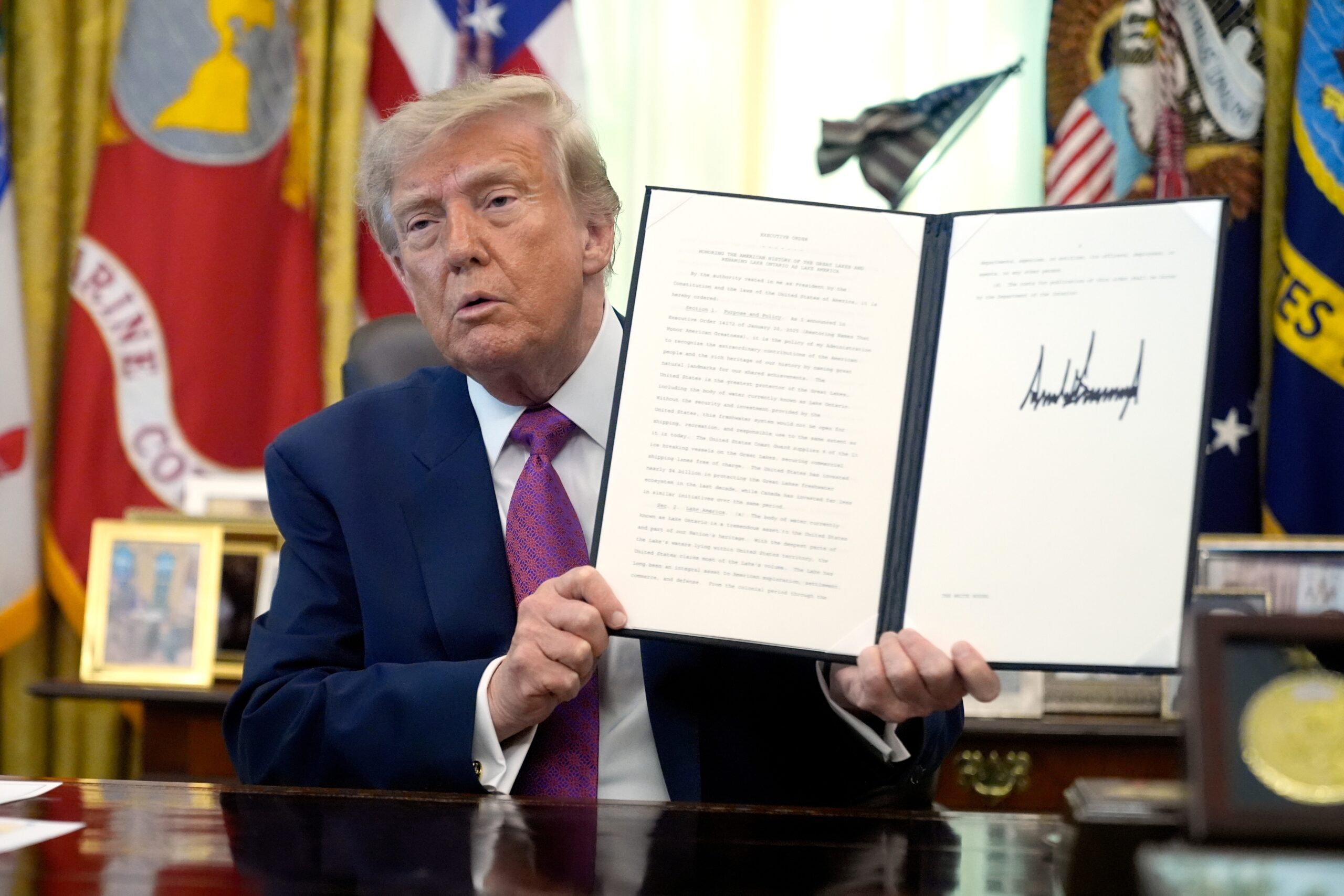
President Donald Trump signed an executive order on Thursday that will change how the United States refers to Lake Ontario in official government records. Under the new directive, federal agencies will identify the waterway as “Lake America” within the United States, a move that has quickly drawn criticism from Canadian leaders and some American officials.
The order was signed in the Oval Office during a public event at the White House. Trump sat at the Resolute Desk with large maps displayed nearby. One map showed the Great Lakes region with the words “Lake America” printed over Lake Ontario. Another carried the slogan “Making the Great Lakes Even Greater.”
The executive order directs the Interior Department to update federal naming systems and government databases. While Trump declared the change effective immediately, the document gives agencies up to 30 days to complete the updates.
The decision does not affect Canada’s use of the lake’s traditional name. Since Lake Ontario lies along the border between the two countries, Canada will continue to recognize and use the historic designation. The order only changes how the U.S. government refers to the lake in official documents, maps, and records.
The announcement comes at a time of growing tension between Washington and Ottawa. Trade relations between the two allies have worsened after the United States imposed new tariffs on Canadian products. The measures affect about $20 billion worth of imports and include a tariff rate of 50% on targeted goods.
The tariffs followed the collapse of trade talks between the two countries. In response, Canada introduced its own tariffs on approximately $20 billion worth of American products. The Canadian measures cover a range of items, including steel products, dairy goods, household appliances, and agricultural equipment.
Trump has frequently criticized Canada’s trade policies since returning to the White House. He has argued that the United States has not received fair treatment in trade and defense matters. In recent months, he has also made comments suggesting that Canada could become part of the United States as a 51st state, an idea strongly rejected by Canadian leaders.
Speaking after signing the order, Trump said the name change was not intended to send a specific political message. However, he repeated his criticism of Canada’s economic relationship with the United States and argued that changes were needed.
Canadian officials responded quickly to the announcement. Prime Minister Mark Carney rejected the new name and defended the historical importance of Lake Ontario. He pointed to the lake’s Indigenous origins and noted that the name existed long before the creation of modern Canada and the United States.
Carney said the lake has been known as Lake Ontario for generations and will continue to carry that name in Canada. His comments reflected the position of the Canadian government, which has no plans to recognize the U.S. change.
Ontario Premier Doug Ford also dismissed the order. He stated that Lake Ontario remains Lake Ontario for Canadians and for people around the world. Other provincial leaders offered similar reactions, describing the move as unnecessary and symbolic.
Nova Scotia Premier Tim Houston criticized the decision as political theater and said the lake’s established name should remain unchanged. The comments highlighted the broad opposition that emerged across Canada following the announcement.
Reaction also came from the United States. New York Governor Kathy Hochul said her state would continue using the name Lake Ontario. New York shares a border with the lake and has long been connected to its economic and cultural importance.
The name Ontario comes from a Huron Indigenous word that means “lake of shining waters.” Historians note that the lake’s name has deep roots in the region and later inspired the name of the Canadian province established in the nineteenth century.
Experts say there is no single international authority that controls the naming of all lakes and waterways. Countries can choose how geographic features are labeled in official records. As a result, different names can exist for the same location depending on the nation and context.
The order follows Trump’s earlier effort to rename the Gulf of Mexico as the “Gulf of America” for U.S. government use. That decision generated significant debate and international attention.
Before ending the event, Trump suggested that other geographic name changes could be considered in the future. While he spoke in a light tone, the remarks ensured that the discussion surrounding the Lake Ontario Renaming Order will likely continue in both the United States and Canada.
