


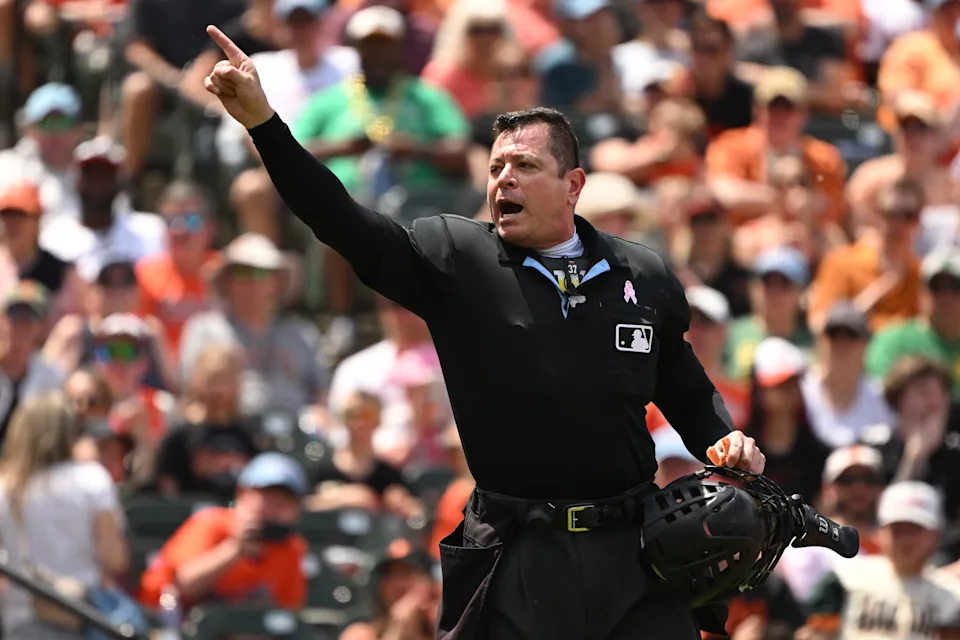
A Major League Baseball game on May 10 sparked fresh debate over the Automated Ball-Strike system after an umpire used his discretion to deny two separate challenge requests, showing that human control still plays a key role in the new technology-driven system.
The incident took place during a game involving the Baltimore Orioles and the Athletics, where home plate umpire Carlos Torres refused two Automated Ball-Strike (ABS) challenges. The Orioles eventually won the match 2-1, but the umpire’s decisions became the main talking point after the game.
The ABS system was introduced to reduce human error in ball and strike calls by allowing players to challenge pitch decisions. However, the latest controversy shows that umpires still have authority to reject challenges under specific conditions.
In the first disputed moment in the opening inning, Athletics catcher Shea Langeliers reacted after Orioles outfielder Taylor Ward was called out on a walk. Langeliers appeared to question the call and touched his helmet, signaling a challenge. However, the umpire denied the request, ruling it did not meet the proper conditions.
A second controversy followed in the third inning involving Orioles catcher Samuel Basallo. He attempted to challenge a ball call but was denied because he had already started a play sequence by throwing the ball around the field, suggesting he believed it was strike three. By the time he formally attempted the challenge, the umpire ruled it too late.
The situation escalated further when Baltimore manager Craig Albernaz came out to argue the decision. Although he returned to the dugout, infield coach Miguel Cairo was later ejected for continuing to protest from the bench.
Under MLB rules, players must request an ABS challenge almost immediately after a pitch call, usually within about two seconds. The challenge can also be denied if officials believe it was influenced by teammates or not made properly.
The league’s review system is still relatively new, having been introduced only about six weeks ago. Since its implementation, it has already produced more than 2,200 challenges, with a reported overturn rate of around 53 percent.
The system was designed to improve accuracy in strike zone calls, but the latest incidents highlight ongoing confusion about timing rules and umpire discretion. Critics argue that unclear enforcement can create frustration for players and managers.
Interestingly, Baltimore catcher Adley Rutschman had previously raised concerns about the system in an interview, suggesting that a stricter challenge timer might be needed to avoid disputes over timing and fairness.
The controversy is not the first involving ABS rules this season. Earlier in March, Minnesota Twins manager Derek Shelton was ejected after arguing over a similar timing issue involving a challenge attempt.
As MLB continues testing the ABS system, debates are growing over how much authority should remain with umpires versus automated technology. While the system is designed to reduce human error, recent events show that human judgment still plays a decisive role in key moments of the game.
The latest dispute has added to ongoing discussions across baseball about how technology should be balanced with traditional officiating in the modern era of the sport.
