


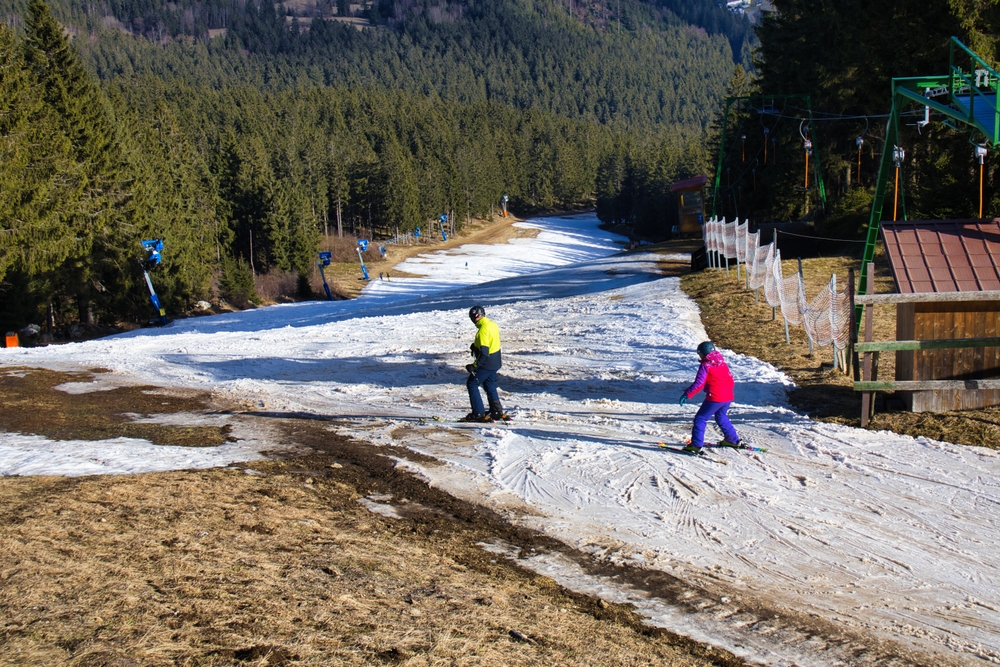
Europe’s ski industry is facing a crossroads. Warmer winters and shrinking snowfall are forcing resorts across the continent to rethink how they operate, with rising costs and environmental pressures threatening the traditional winter sports model.
Snowfall Is No Longer Guaranteed
Even in Italy’s famous Dolomites, where the Winter Olympics will open in Milan-Cortina on 6 February, snow is increasingly unreliable. Resorts now rely heavily on artificial snowmaking to keep slopes open. While effective, snow cannons are expensive to run and place a huge strain on water and energy resources, costs that ultimately fall on skiers through higher lift passes. For many tourists, winter sports are becoming increasingly out of reach.
Climate Change Threatens the Olympic Landscape
The effects of climate change are already reshaping Europe’s winter sports landscape. Higher temperatures and shorter winters are affecting the entire Alpine region. The International Olympic Committee has recognized these challenges, highlighting the threat to future Winter Games. A 2021 study found that, without urgent action, only four former Olympic host cities — Lake Placid (US), Lillehammer and Oslo (Norway), and Sapporo (Japan) — would remain viable by 2050. Under worst-case warming scenarios, almost all historic sites could be snowless, leaving only Sapporo as a viable option by 2080. Even if global warming is limited to 2°C, only a fraction of past host cities could realistically stage the Games.
Water, Energy, and Rising Costs
Snowmaking is extremely resource-intensive. Creating just 30 centimeters of snow on a one-hectare slope can require over one million liters of water — roughly what a city of 1.5 million people uses in a year. Powering snow machines also consumes vast amounts of electricity, producing greenhouse gas emissions that worsen the climate crisis. Estimates suggest supplying artificial snow to all Alpine resorts would demand about 600 GWh, equivalent to the annual consumption of 130,000 households.
These costs are hitting visitors directly. Ski spending in Europe has risen nearly 35% since 2015, outpacing inflation, with Switzerland, Austria, and Italy seeing the steepest increases. Combined with environmental pressures and the uncertainty of natural snowfall, Europe’s ski resorts face a future where winter sports may no longer be accessible or sustainable for the average tourist.
