


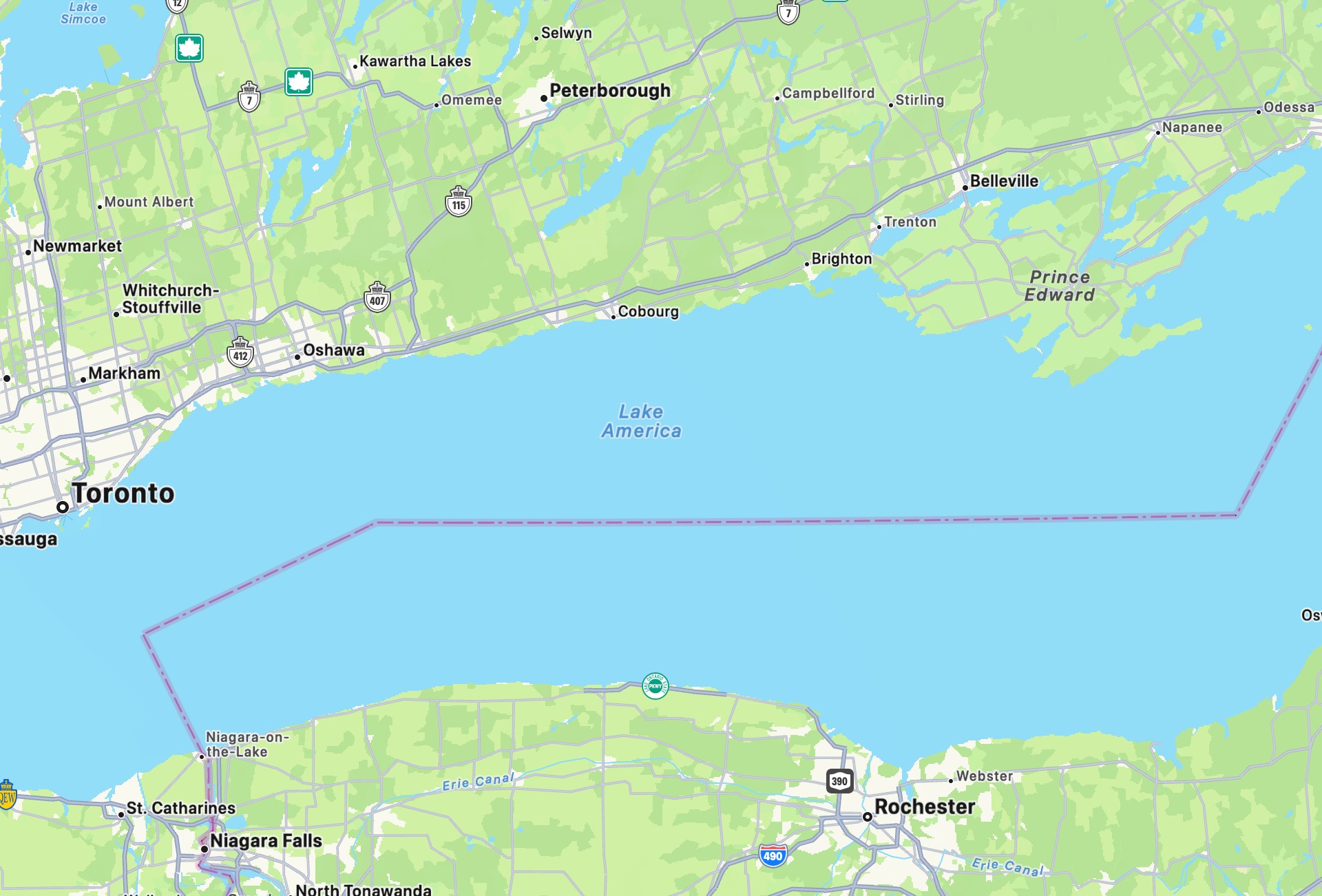
Apple has officially updated its Maps application for users in the United States, replacing the long-standing name Lake Ontario with “Lake America.” The move follows a recent executive order signed by President Donald Trump and marks another chapter in a growing dispute between the United States and Canada.
The update affects only users located in the United States. People using Apple Maps in Canada continue to see the traditional Lake Ontario name. In many other countries, mapping services may display both names depending on local settings and policies.
Lake Ontario is one of North America’s five Great Lakes. It borders New York state in the United States and the province of Ontario in Canada. The lake has carried its historic name for hundreds of years and plays an important role in the culture, economy, and history of both countries.
Apple had been considering how to respond to the executive order for several days. Reports suggested that President Trump personally encouraged the company to adopt the new name. After the update appeared on Apple Maps, the White House praised the decision.
Trump described the adoption of the new name by major technology companies as proof that the renaming effort had been completed. He said the change reflected national pride and celebrated the contributions of Americans throughout history.
Despite the announcement, the United States has no authority to force Canada or other nations to recognize the new name. Canadian officials have rejected the change and continue to refer to the lake as Lake Ontario.
Canadian Prime Minister Mark Carney criticized the decision and defended the historic name. He noted that the word Ontario comes from the language of the Indigenous Wendat people. According to Canadian leaders, the name has existed for centuries and remains an important part of the region’s heritage.
Ontario Premier Doug Ford also voiced opposition. Provincial officials recently unveiled a large sign along the shoreline carrying the message “Lake Ontario, Now and Always.” The display was intended to reinforce support for the traditional name and highlight Canada’s position in the dispute.
The naming disagreement comes at a time of worsening trade relations between the two countries. Trade negotiations between Washington and Ottawa broke down in recent weeks. Soon after, the United States introduced major tariffs on selected Canadian imports.
American officials also warned of additional duties on products such as steel, vehicles, trucks, and auto parts. Canada responded with its own tariffs on a wide range of American goods. The measures have increased tensions between two of the world’s closest trading partners.
While the executive order focused on geography rather than trade, many observers believe the timing is significant. The renaming effort arrived shortly after public disagreements over tariffs and economic policy.
The administration said the change was part of a broader effort to honor American achievements and recognize important landmarks. Officials argued that the new name reflects national history and shared accomplishments.
Apple is not the only technology company to make the adjustment. Another major mapping platform updated its service earlier and adopted the same approach. Under its policy, users in the United States see “Lake America,” while users in Canada continue to see “Lake Ontario.” International users may see both names displayed together.
The issue has also sparked debate in the technology industry. Some companies have chosen not to follow the executive order. One navigation app publicly announced that it would keep the Lake Ontario name. The company shared its position online and quickly gained attention from users.
The response was immediate. Large numbers of people downloaded the app, helping it rise to the top of app store rankings in the United States. Supporters praised the company for maintaining the historic name despite political pressure.
For now, the lake carries different names on different digital platforms depending on where users are located. As political and trade tensions continue, the debate over the lake’s identity shows how geography, technology, and national pride can become closely linked in the digital age.
