


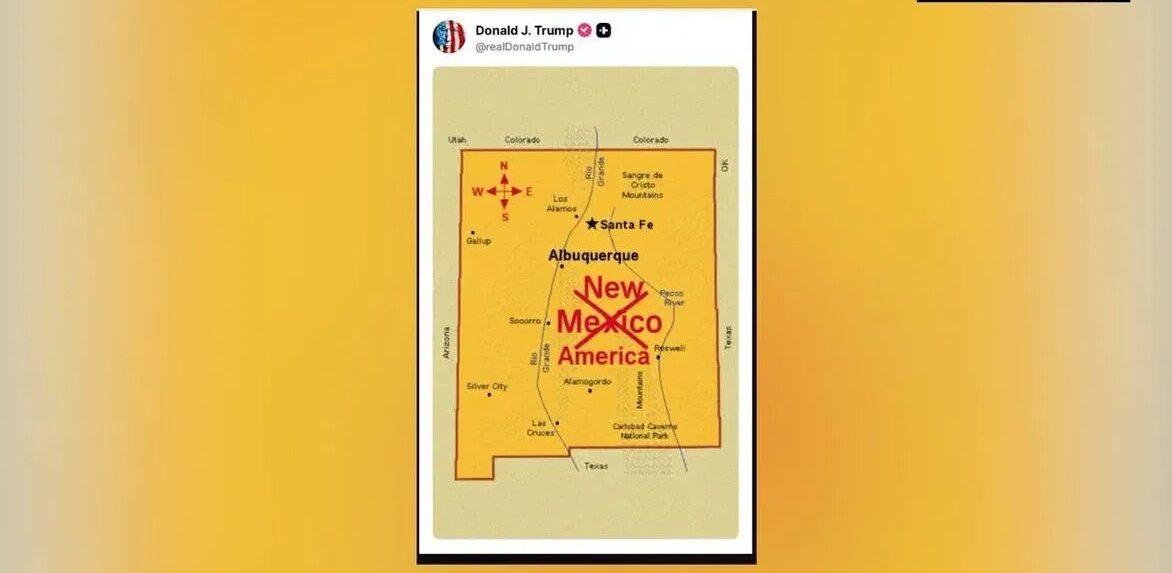
President Donald Trump has triggered fresh debate after sharing an image that appeared to suggest a new name for the state of New Mexico.
The image showed the shape of New Mexico with the word “Mexico” crossed out. In its place was the word “America.” The post was shared on social media and later reposted by the White House. No statement was released to explain the image or its purpose.
The post quickly gained national attention. It also raised questions about whether the administration planned to push for an official name change. However, no proposal has been announced, and federal officials have not confirmed any effort to rename the state.
The image came shortly after Trump signed an executive order changing the federal name of Lake Ontario to “Lake America.” That move followed another executive order issued at the start of his current term that renamed the Gulf of Mexico as the Gulf of America in federal records.
These actions have become part of a broader pattern in which Trump has used executive authority to change the names of well-known geographic locations. Supporters view the changes as a display of national pride. Critics see them as political gestures that create controversy without solving major problems.
Legal experts point out that states are different from geographic features such as lakes, rivers, and gulfs. A president can direct how certain locations are listed in federal naming systems. However, a president does not have the authority to rename a state through executive action.
Any change to a state’s name would have to come through legal procedures within that state. Such a move would require approval through state government processes. Because of that, New Mexico cannot be renamed by a presidential order.
New Mexico Governor Michelle Lujan Grisham strongly opposed the suggestion. The Democratic governor said the state’s name is settled and not open to discussion. She argued that the administration should focus on more important national concerns.
In public comments, she said residents of New Mexico were working on real issues while political attention was being directed toward symbolic matters. She also criticized the administration over economic and foreign policy concerns.
Senator Martin Heinrich, who represents New Mexico in the U.S. Senate, also rejected the idea. He stated that he would continue to use the traditional names of New Mexico, the Gulf of Mexico, and Lake Ontario.
The discussion has also brought attention to the long history behind New Mexico’s name. Historical records show that the name existed centuries before the United States was founded. The region carried the name during the Spanish colonial era and long before it became part of the United States.
For many people in the state, the name is more than a geographic label. It reflects generations of history, culture, and community identity. Residents often point to the state’s rich mix of Native American, Hispanic, and American traditions as part of that heritage.
Trump has often used high-profile announcements and symbolic actions to highlight presidential authority. Changes to place names have become one of the most visible examples of that approach during his time in office.
The recent Lake Ontario decision came during a period of trade tensions between the United States and Canada. That change drew reactions from political leaders and observers in both countries.
Trump has also hinted that additional name changes could be considered in the future. After announcing the Lake Ontario change, he joked that one or both oceans bordering the United States might someday receive new names as well.
Although the comment was made in a light tone, it added to public discussion about how far such naming efforts could go. It also reinforced Trump’s interest in using national symbols to make political statements.
At present, New Mexico remains unchanged. Yet the image shared by Trump has once again placed the issue of geographic names in the national spotlight. The debate has become a new flashpoint in the ongoing discussion over history, identity, and the limits of presidential power in the United States.
