


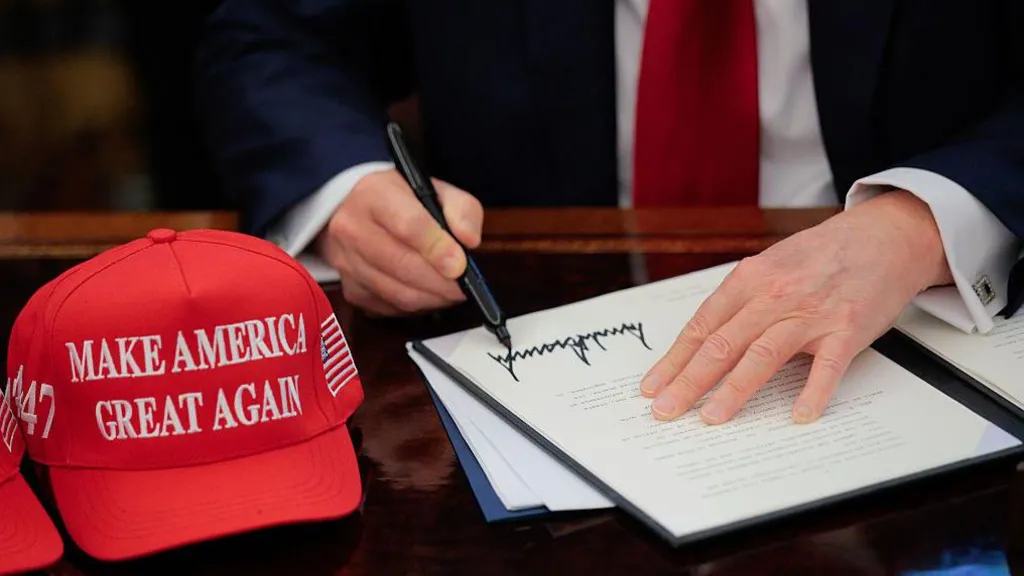
Tariffs have remained a central part of US President Donald Trump’s economic strategy since returning to the White House. The administration argues that import taxes help strengthen domestic manufacturing, protect American industries, and generate government revenue.
Supporters view tariffs as a tool to encourage investment in the United States, while critics warn they can increase costs for consumers and create uncertainty for businesses involved in international trade.
A tariff is a tax placed on imported goods. The charge is usually calculated as a percentage of the product’s value. Companies importing products into the United States pay the tariff to the government.
Businesses often respond by increasing prices, absorbing part of the cost, or reducing imports. As a result, tariffs can affect consumers, manufacturers, retailers, and supply chains across multiple industries.
The Trump administration says tariffs are intended to encourage consumers and businesses to buy products made in the United States. Officials also argue that tariffs help address trade imbalances between the US and its trading partners.
The administration has frequently focused on the US trade deficit, which measures the difference between the value of goods imported into the country and the value of goods exported abroad.
According to Trump, countries that sell significantly more products to the United States than they purchase from it benefit from an unfair advantage. Tariffs are presented as a way to reduce that imbalance and support domestic production.
The policy has become one of the defining features of Trump’s economic agenda.
However, the administration faced a major legal challenge in 2026 when the US Supreme Court ruled that the president had exceeded his authority by using emergency powers to impose certain tariffs without congressional approval.
The decision affected tariffs introduced under the International Emergency Economic Powers Act, including measures targeting Mexico, Canada, and China.
The ruling also impacted tariffs announced during what the administration referred to as “Liberation Day” in April 2025.
Those measures imposed tariff rates of up to 50 percent on products from dozens of countries, including Cambodia, Vietnam, and Malaysia.
Following the court ruling, billions of dollars collected under those tariffs were returned to affected companies.
Court filings indicated that approximately $100 billion had already been refunded, representing a significant portion of the total amount collected under the policy.
Despite the legal setback, the ruling did not end the administration’s broader tariff strategy.
Instead, the White House turned to other trade laws to maintain import duties on foreign products.
One approach involved Section 122 of the Trade Act of 1974, which was used to introduce temporary tariffs on global imports.
Although those measures later expired, they were replaced by new tariffs ranging from 10 percent to 12.5 percent on goods imported from many of America’s largest trading partners.
These trading partners include the United Kingdom, the European Union, and China.
The administration also used Section 301 of the Trade Act of 1974 to support additional trade actions.
Officials argued that some trading partners had not done enough to address concerns related to forced labor practices.
The policy has faced legal opposition. A coalition of 25 US states has challenged the tariffs in court, arguing that the measures are unlawful and unsupported by the evidence presented.
The administration has also announced country-specific tariffs.
Brazil faced tariffs on selected products under claims that trade policies had harmed American economic interests.
Meanwhile, Canada was targeted with a 50 percent tariff on a range of goods. The administration cited concerns about trade treatment involving automobiles, dairy products, and alcoholic beverages.
The ongoing debate over tariffs continues to influence global markets and international trade relations.
Supporters believe the measures can strengthen domestic industries and reduce dependence on foreign imports. Critics argue that higher costs may ultimately be passed on to consumers and businesses.
As legal challenges continue and new trade policies emerge, the Trump tariff policy remains one of the most closely watched elements of US economic strategy.
