


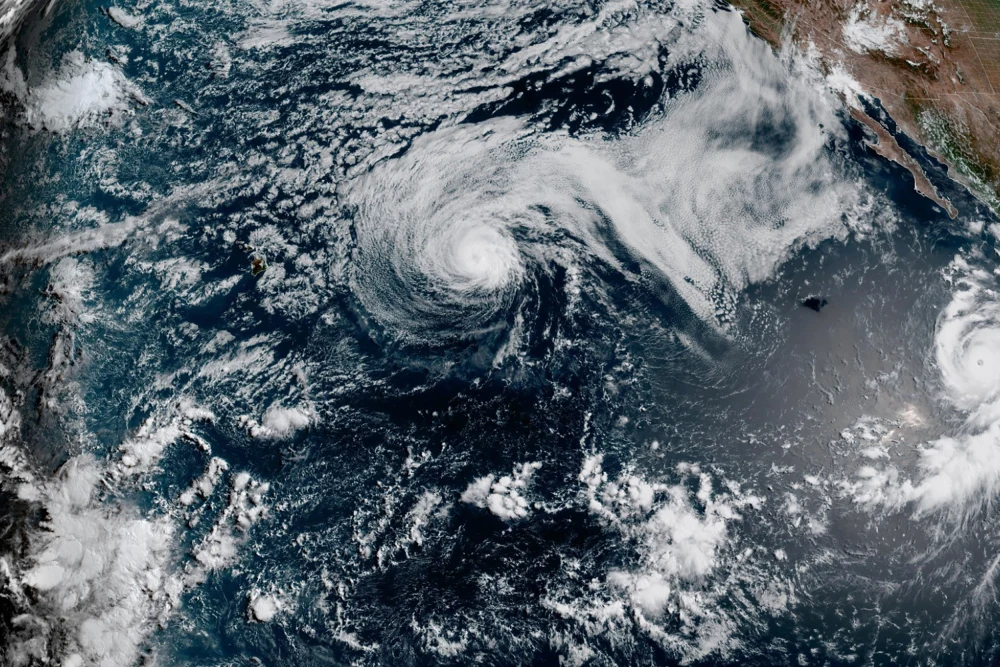
Major Hurricane Genevieve continued to move across the eastern Pacific Ocean on Monday, while Tropical Storm Fausto weakened near Hawaii but still generated dangerous surf and strong currents across parts of the island chain.
According to the U.S. National Hurricane Center, Genevieve remained a powerful hurricane far from land and posed no immediate threat to coastal communities. The storm briefly reached Category 5 strength earlier in the day, becoming the first Category 5 hurricane recorded in the eastern Pacific basin in two years.
Meteorologists reported that Genevieve was maintaining maximum sustained winds of 145 mph. Although the storm had weakened slightly from its peak intensity, it remained a major hurricane capable of producing powerful ocean swells and hazardous marine conditions.
As of Monday evening, the center of Genevieve was located approximately 505 miles southwest of the southern tip of Mexico’s Baja California Peninsula. The hurricane was moving toward the northwest at around 12 mph.
Forecasters expect the system to remain over open waters and continue on a path generally parallel to Mexico’s Pacific coastline. Current projections indicate that Genevieve will stay well offshore and avoid direct landfall.
No coastal watches or warnings were in effect for Mexico. However, weather officials warned that large swells generated by the hurricane were already affecting portions of southwestern Mexico and the Baja California Peninsula.
The National Hurricane Center said these swells could create dangerous surf and strong rip currents along affected coastlines. Beachgoers and small vessel operators were advised to remain cautious as ocean conditions continue to deteriorate.
While Genevieve is expected to remain a major weather system over the next several days, forecasters noted that fluctuations in intensity are possible. The hurricane may strengthen and weaken at different stages before a more sustained weakening trend develops later in the week.
Meanwhile, attention is also focused on Tropical Storm Fausto, which continued moving across the central Pacific Ocean.
Earlier in its life cycle, Fausto reached hurricane strength. By Monday evening, however, the system had weakened into a tropical storm as it approached waters northeast of Hawaii.
Despite the weakening trend, Fausto continued to produce impacts across the Hawaiian Islands. Weather officials reported increasing surf heights and stronger ocean currents along east-facing shores throughout the state.
As of the latest advisory, Fausto had maximum sustained winds of 70 mph. The storm was located approximately 415 miles east-northeast of Hilo on Hawaii’s Big Island and was moving west-northwest at about 16 mph.
Forecasters currently expect Fausto to pass north of the Hawaiian Islands rather than move directly over the state. Even so, emergency officials and meteorologists are encouraging residents to closely monitor the storm’s progress.
Tropical systems do not need to make landfall to create hazards. Large waves, rough surf, strong currents, and coastal flooding can occur even when a storm remains hundreds of miles offshore.
Hawaii frequently experiences these indirect effects from tropical systems moving through the Pacific basin. Ocean conditions can become dangerous quickly, especially for swimmers, surfers, and boaters.
The simultaneous presence of Genevieve and Fausto highlights the active nature of the Pacific hurricane season. Warm ocean temperatures and favorable atmospheric conditions have supported the development of multiple tropical systems across the region in recent weeks.
Weather experts continue to monitor both storms around the clock. Satellite imagery, aircraft observations, and computer forecast models are being used to track changes in strength and movement.
For now, Genevieve remains the stronger of the two systems and one of the most powerful storms of the 2026 eastern Pacific hurricane season. Although it is expected to stay away from populated areas, officials caution that its ocean impacts could still affect parts of Mexico’s Pacific coast.
At the same time, Fausto’s weakening trend is expected to continue as it moves north of Hawaii. Nevertheless, residents and visitors across the islands are being urged to remain aware of changing weather and ocean conditions until the storm moves farther away from the region.
