


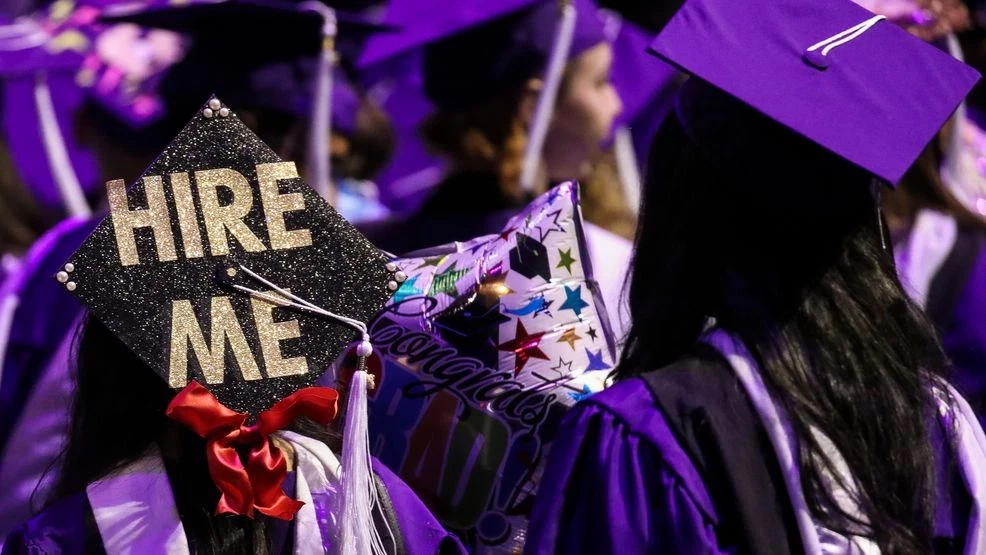
Each May, thousands of college graduates gather in places like Washington Square Park in New York City to celebrate the end of student life and the start of their careers. But for many in the United States this year, that moment of joy is mixed with worry about the future.
New graduates are entering a job market that is much weaker than expected. Hiring has slowed across several industries, while economic uncertainty and technological change are making it harder for young workers to find entry-level jobs.
Julie Patel, who recently completed a master’s degree in public health, said her job search has been more difficult than she expected. She explained that conditions in the labour market are very different from what she imagined when she started her studies.
Economists say the problem is not just one factor but a mix of issues. These include global conflicts, policy uncertainty, budget cuts, and the rapid rise of artificial intelligence in workplaces.
Recent data from the United States Bureau of Labor Statistics shows that job openings remain high at 6.9 million. However, hiring activity is slower than before. Employers are filling fewer new roles, and many workers are staying in their current jobs instead of moving.
This situation creates what experts call a “low turnover” labour market. It means fewer opportunities for new graduates trying to enter the workforce for the first time.
Elise Gould and Joe Fast from the Economic Policy Institute say the lower hiring rate is making it harder for new entrants to secure jobs. They also note that companies are cautious due to ongoing economic uncertainty.
Overall job growth has also slowed. In early 2026, the US economy added an average of 68,000 jobs per month. This is a sharp drop compared with previous years, when monthly gains were much higher.
Some sectors are still hiring, especially healthcare, transportation, and retail. But white-collar industries such as finance and information services have seen job losses.
Experts describe the current situation as a “no-hire, no-fire” environment. Companies are not laying off many workers, but they are also not expanding hiring at the same pace as before.
This creates extra pressure for graduates, who must compete not only with their own classmates but also with experienced workers who are re-entering the job market after layoffs or funding cuts.
Public sector jobs are also shrinking in some areas. Funding reductions in research and government programs have led universities and institutions to freeze hiring or cut positions.
Several universities, including major research institutions, have slowed recruitment due to reduced funding. This has directly affected fields like public health, where many graduates are seeking entry-level roles.
Patel and other graduates say this has increased competition for every available position. Even internships are becoming more difficult to secure, as students compete with both new graduates and laid-off professionals.
Artificial intelligence is another major factor changing the job market. Studies show that early-career roles, especially in technology and customer service, are being affected by automation tools.
Research from Stanford Digital Economy Lab found that employment for early-career workers in AI-exposed sectors has declined significantly. At the same time, demand for experienced professionals remains stable or even growing.
Experts say AI is reshaping entry-level work by replacing some tasks and reducing the number of starter positions available in companies.
Some reports also suggest that AI may reduce thousands of jobs each month in the coming years if adoption continues at its current pace.
Industry leaders warn that within five years, a large share of entry-level white-collar roles could be affected by automation. This has created uncertainty among students preparing to enter the workforce.
Graduates are also facing new challenges in the hiring process itself. Many companies now use AI tools to screen applications, which increases competition and reduces response rates for job seekers.
Some applicants say they send dozens of applications but receive only a small number of replies. Others report being interviewed first by AI systems before speaking to human recruiters.
Experts say this shift is making the hiring process faster for companies but more difficult for new job seekers.
Despite these challenges, graduates continue to look for opportunities across different sectors. Many are adjusting expectations and applying to a wider range of roles.
For students like Patel, the transition from education to employment is no longer predictable. Instead, it has become a competitive and uncertain process shaped by economic changes, technology, and global events.
As graduation season continues across the United States, the gap between academic achievement and job market reality is becoming more visible.
